Students sometimes come forward with statements like, “I just want to fight.” They see old-time pictures, or flowery seeming practices and image a lot of wasted effort that won’t result in being able to throw a good punch, or land a good kick. And sometimes they’re right. Some schools do emphasize form over function, or the branches have gotten too far from the roots.
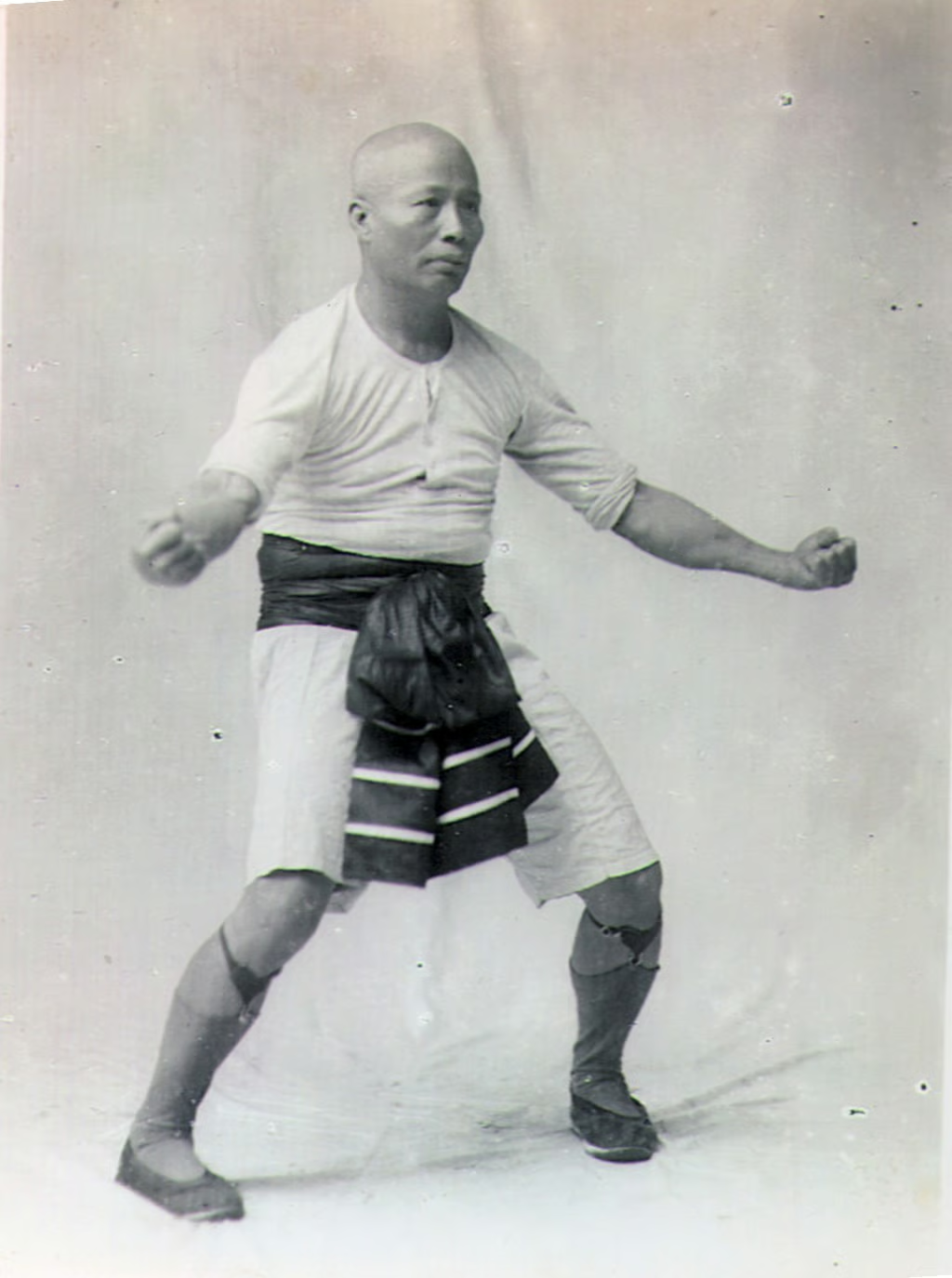
Me? I can only respond: “The old ways are best…because they teach you how to fight.” Chinese martial arts are practical because they are traditional
We should start by asking: What does it take to fight? What circumstances are you fighting in? What is the best way win? And a million other similar questions demand lots of different answers. The “old ways” provide context and specifics for answering all of them.
So, what are “the old ways” of Chinese kung fu and how do they teach you to fight? Equally, what misconceptions are hidden in the students’ assertions that might need challenging?
Chinese Martial & Military Arts: The Old Ways
Chinese kung fu, traditionally speaking, is the epitome of military technology of it’s time. Naturally, it morphed and transitioned based on the circumstances of those times. What’s handed down to us today are the practices and applications of the 1850s-1970s, including para-military, private security, and street fighting. Indeed, the traditional approach to training encapsulates mechanisms, both official and social, into a system that demanded regular transformation. In this sense, traditional kung fu is a mixed martial art.
Take for granted that “mixed martial art” as we know it today is a brand and a social phenomenon. Consider instead the simple Wikipedia statements as a starting point:
Mixed martial arts: full-contact combat sport based on striking and grappling, incorporating techniques from various combat sports from around the world.
The precursors of modern MMA existed in various parts of the world since the ancient period to the 20th century in different forms. Prior to 1970s, various inter-stylistic contests and/or no-holds-barred bouts took place throughout different countries in East Asia. One example is from mid-20th-century Hong Kong, where rooftop street fighting contests between different martial arts styles occurred.
Certainly, Wikipedia presents a reasonable starting point, and points to Leitai (擂 台 ‘thunder’ platform) competitions. Classifying all of it as “sport.” And cites modern popular culture as it’s sources. This is misleading.
What is missing from this, and most, explanations is the link to the promotion systems of non-commissioned officers in the Chinese military. In short, akin to the national exams offered to scholars, in the army performances and matches were arranged when armies were mustered. This naturally brought together practices and techniques from across the country and the empire. These were then tested against each other, with winners receiving what we would call “non commissioned officer” status today. As these men returned home, they would often teach their close family or clan members so that when they were mustered, they’d have better chances of advancement. One aspect of this is readily recognized by considering the exclusive nature of even 20th century teachings (e.g. don’t teach foreigners) and secretive practices (e.g. “closed door disciples”).
Therefore, “traditional kung fu” is that which continues these mix and match approaches, with an eye to what has already worked before – and in what circumstances.
Circumstances radically changed in China, and therefore in the traditional martial arts, in the 1850s. As losses to the 8 Nation Armies mounted, and modernization of Qing and Republican army organization, mounted the training radically transformed. The hand-to-hand and cold-steel training, and important advancement opportunities, were relegated to quasi-military organizations such as court enforcers (call them “police” if it helps) and private security. Therefore, the battlefield circumstance were greatly de-emphasized. One-to-one and small group situations took the place of formations of 1,000s.
This became the fodder for growing pop-culture entertainment at much the same time, and in similar ways, as cowboys did for America or knights for Europe.
This is, of course, to put it all very, very simply. Please see the further reading below for substantiation.
What makes Hung Gar traditional?
Starting from the pop-culture angle above: Hung Gar was fantastically founded by Hung, Hsi Guan (Hong, Xi Guan 洪熙官), at best a folk hero. More likely an invention. From the novel “Emperor Qanlong’s Tour of Jiangnan” we get such tropes as the “Five Elders of Shaolin,” Wu Mei, the White-browed Taoist and the burning of the Shaolin Temple, not forgetting to mention the connection to the monk Chee Shan (Zhi Shan, 至善).
One can easily compare this to Wyatt Earp and Tombstone. Some of the exploits happened, but completely unlike the actuality. Simply read the Tombstone court records and then watch the any “shoot out at the OK corral” movies to get the idea.
Even so, fantastical beginnings start to look more concrete with Huang, Fei Hung (Huang Fei Hong, 黃飛鴻). We can be certain enough about his 1847 birth, and understand enough about his upbringing to see how his life matches the societal transformations mentioned above. Specifically, as the northern China society transformed towards modernity with activities such as the Self Strengthening Movement (Zi Qiang Huo Dong, 自強活動), the southern promises slow rolled this. Huang, Fei Hong reportedly did some work in training the local army and militias, as did some of his students such as Lu, Zhenggang (陸正剛), reportedly a body guard for the first president of the republic, Sun, Yat Sen. More importantly Huang, Fei Hong reportedly worked private security for a variety of entertainment venues.
Despite some pop-culture shenanigans such as newspaper accounts of his exploits, movies and TV programs of his life, we can be absolutely certain of Lam, Sai Wing (Lin, Shi Rong 林世榮) with some study and exposure. As for study, the modern records since his birth in 1861 and death in 1944 can be read. As for exposure, we have direct reporting from his family who have continued the training traditions. Perhaps most notably his grand-nephew Lam Cho (Lin Zu 林祖). Lam Cho hardly needs an introduction, nor do his sons Lam, Chun Fai (pictured below); Chun Chong, Chun Sing. Even someone like myself has met them, and trained under them.
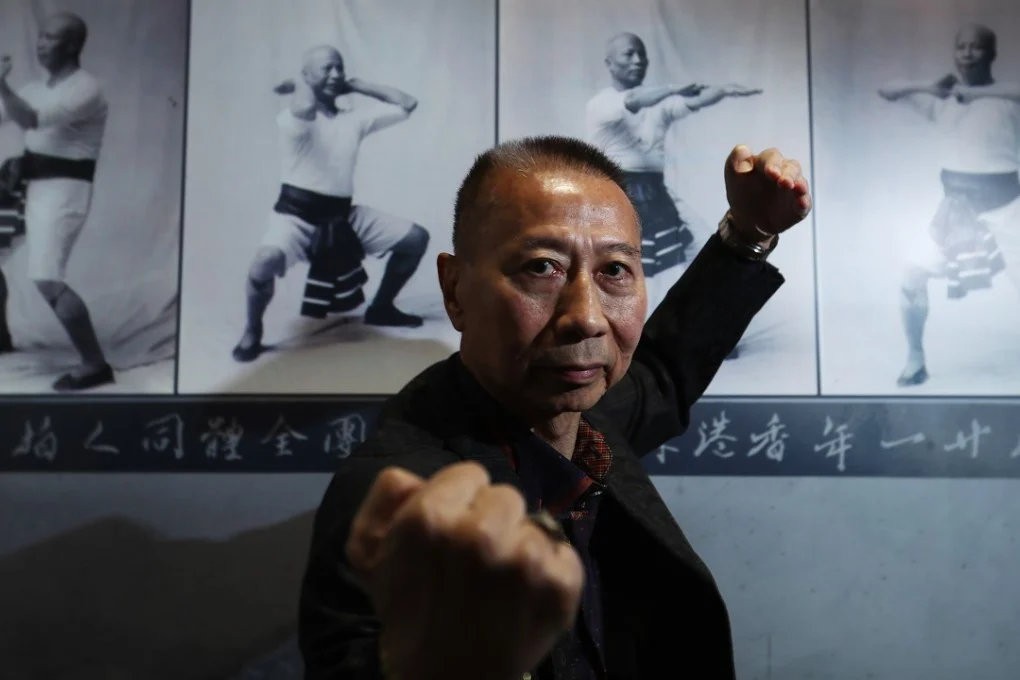
The recitation of lineage here is less to emphasize it’s importance or effectiveness, but to show how the “old ways” training has fairly uniquely transferred from the 1850s late Qing, through the Republican and into the modern era. The roots of military techniques and practices can be found in the transmission, as can practical improvements along the way.
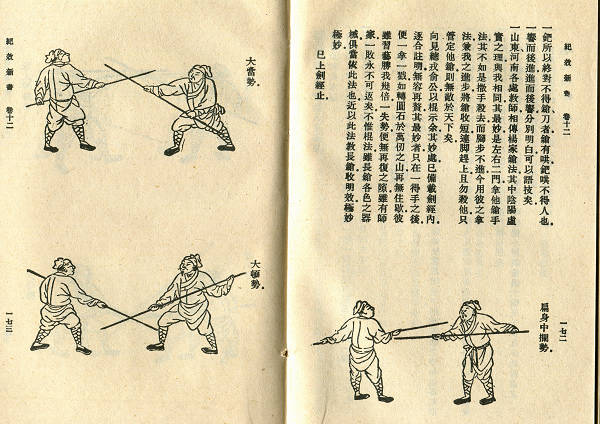
For a simple example, to be expounded on later, are the Hung Gar “Ba Gua Gun” (eight trigram pole 八卦棍) and it’s two-person sparring version, which can readily be compared to spear practices illustrated in Qi, Ji Guang’s (戚繼光) Ming era training manuals for coastal para-militaries, such as the “New Book on Military Efficiency” (紀效新書, pictured below). Which, in and of itself, illustrates the transitions mentioned above as these manuals were meant to teach para-militaries along the coast to fight raiders, not invading armies. Therefore, while they had explanations of formations, ordering troops and camps, they also included illustrations of practical drills to be led by locals who would have recognized them. One can easily imagine the fertile soil that the manuals must have been tossed into.
For another example, the Hung Gar sparring set “Taming the Tiger Two-man” (工字伏虎對差), it was transformed by the Lam’s into the “Tiger and Crane two-man” (虎鶴對差) with several tweaks and re-focuses.
What are Hung Gar’s ways?
We’ve covered why these ways are old. Now, what are they?!
To fight, you must have above-basic fitness. Put simply, one must throw a punch and have it land with impact. This requires strength, speed and flexibility. Equally, to land, the punch has to be thrown from a good position, allowing for the location and angle of yourself to the opponent. This requires situational and spatial awareness, in the heat of the moment. One must also understand that heat. It is one thing to get into a sporting ring, another to face a drunk friend or stranger and altogether something else to be faced with an armed mugger or rapist.
How does one train for all these and more, while also not simply injuring oneself? After all, if you are constantly hurting yourself in training, you can’t fight very effectively when the challenge arises.
Hung Gar’s answer is traditional not only because of the lineage, but also because it focuses on sets. Long routines of choreographed moves, both fists + feet and weapons. These start as solo activities, build up towards two-man and weapons plus even two-person weapon sets. Then, naturally, sport sparring, self-defense and finally pointers on how to apply it all in serious situations.
Students questions hide assumptions about effectiveness and time-to-practical ends…
- Isn’t this too long a road? Maybe. When the road itself is seen as the “end.”
- Doesn’t this make kung fu flowery and impractical? It can – when there is an over-focus of the form over the function.
- Aren’t there more modern and speedy approaches to fighting? Maybe. However, even with modern MMA, you must do calisthenics, bag work and other drills. There is no escape from foundations! Hung Gar practices provide an excellent, all bases covered, pathway towards mastery that lands strikes quickly, effectively and with minimal risk to you.
Solo sets drill the body to develop high levels of cardio and muscular strength, including flexibility, speed and positioning. Two-person sets build on that fitness, and further develop calmness in a heated moment, close-up with your opponent. Naturally, weapon practice develops all the above, plus helps in societal disputes where impromptu weapons, or cold-weapons are more likely. In all of this, the pedigree and legacy are handed down technology that has stood the test of time.
Nevertheless, you must make it yours. After all being fit is very personal. You’ll evolve your own style of favored techniques, in the confidence that they’re drawn from a dictionary and encyclopedia of tried and true methods.
In this sense, traditional martial arts is like learning a language, or music. You start out with the most basic building blocks: vocabulary. Or notes. You build up to basic phrases, or scales. Progression requires much practice and mastery of these basics, as one tackles pat dialogues or simple musical pieces. Next, one can hold basic conversations or join a small band (i.e. spar). Ultimately, one can debate in the second language, expressing deep concepts and winning over audiences. Or fill in unwritten musical gaps with improvisation.
You will find the vocabulary and grammar and approach that is your own way of attacking the situation. But it all starts from the basics, through drills to ultimate mastery and expression. With confidence, and strength – developed through repetition.
As Bruce Lee said:
“…unless human beings have 3 arms and 3 legs, then we will have a different way of fighting. But basically we all have two arms and two legs so that is why I believe there should be only one way of fighting and that is no way.”
However, as the Zen masters he leverages also note: reaching ‘no way,’ is a process. It requires drilling and practice.
Further Reading
- A Military History of China by Graff
- Military Culture in Imperial China edited by Cosmo
- 中国军事通史 (Comprehensive Military History of China, 17 volumes) by Military Studies Academy (China)
- 中國古代武術論文集 (Collection of Discussions in Ancient Chinese Martial Arts) by Lin
- 中国武术史 (History of Chinese Martial Arts) by National Sports Administration, Martial Arts Research Center
- 中國武術史 (History of Chinese Martial Arts) by Zhang
- 中国古代战争通览 (Comprehensive Review of Ancient Chinese Battles) by Zhang
More upon request